

Can you imagine investing in new flooring for your Mississauga home, only to hear creaking, notice gaps, and find loose ends a few months after installation? These annoying situations are mostly due to poor installation. What makes it worse is that installation errors often aren’t obvious right away. Your floor may look perfect, yet it can develop issues within months, and by then repairs can be challenging and expensive.
The good news is that most of these issues are completely preventable with the right knowledge and a proper installation approach. Many reputable flooring suppliers in Mississauga, like Super Choice Carpet & Hardwood, offer professional flooring installation services for error-free, precise installation.
Read this blog to learn more about how to determine whether your flooring is incorrectly installed and how to fix it to ensure it looks great and lasts a long time.
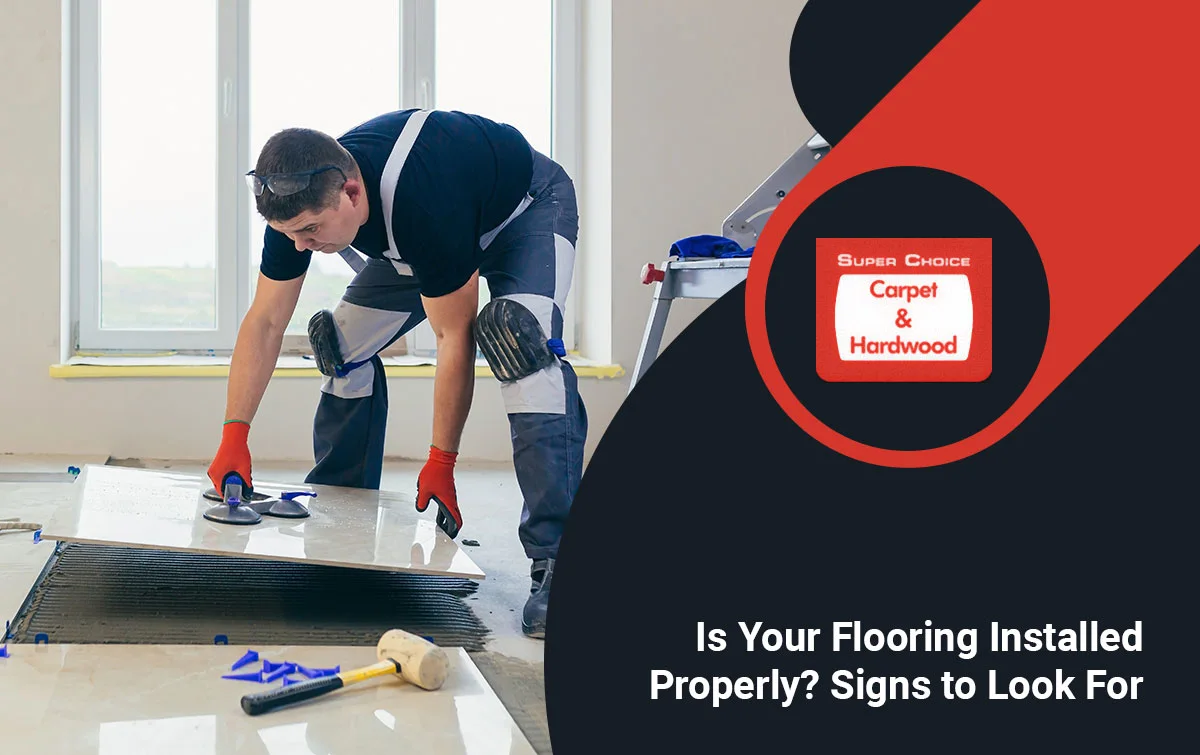
Common mistakes like not prepping your subfloor or skipping moisture testing can lead to an incorrect flooring installation. Address these signs of a bad flooring installation before it becomes a major problem.
A properly installed floor should be even and smooth. If you notice bumps, dips, or unevenness in your floor, it could signal a faulty installation. This issue often occurs when the subfloor isn’t inspected, levelled, or prepared properly before the install, or when moisture is trapped in it.
Over time, placing furniture on the floor can cause a major problem, as it may wobble or not sit properly. Severe unevenness can create a tripping hazard, especially for children and older adults.
Creaking and squeaking sounds are common in the first few weeks after a new flooring installation as the boards or planks need time to adjust to your home’s temperature and humidity. But if the sounds don’t go away after that, it becomes a concern.
Choosing the wrong underlayment, having an uneven subfloor, moisture imbalance, or an inappropriate installation method can cause these sounds.
If you notice your flooring lifting, buckling, or warping at the edges, it may indicate poor installation.
Watch for crowning or cupping in the floorboards, which can result from poor installation. Keeping a very small expansion gap or no gap leaves no room for your floor to expand, which can often lead to these issues. Buckling occurs when the flooring lifts from the subfloor, creating an uneven surface. Moisture seeping into the subfloor or improper nailing often causes this.
A properly installed floor should feel secure and sturdy underfoot. If your floor shifts when you walk on it or feels bouncy, it could also indicate poor installation.
Incomplete or improperly installed trims, thresholds, or transitions can result from inexperienced or rushed installation. Poorly finished flooring edges can let moisture enter between your floor and subfloor, eventually causing damage.
To that end, partnering with a reputable floor installation service provider in Mississauga, like Super Choice Carpet & Hardwood, can help you get flooring that is unproblematic.

Installing new flooring involves several steps, and the outcome depends on how accurately and precisely your installer performs each one. Have a look at some of the major steps:
Select the flooring material based on your room’s function, including foot traffic, moisture levels, and safety requirements, before finalizing your choice.
For instance, vinyl flooring is a smart choice for your kitchen or laundry room because it’s waterproof, highly durable, and can handle heavy foot traffic and dropped items. If you have pets or children, choosing a soft, warm flooring surface for your living and dining areas is a thoughtful decision because it helps reduce slipping or tripping.
A subfloor is the structural surface beneath the finished flooring, and its condition determines how well your flooring will perform over time. While inspecting the subfloor, check whether it is even, structurally stable, free of cracks or debris from previous flooring, and free of trapped moisture.
Over time, cracks will cause the floor to shift. When moisture remains trapped, the floor is more likely to warp. An uneven subfloor can cause the flooring to flex under the weight of whoever walks on it, creating squeaking noises.
It is important to check the amount of moisture trapped in the subfloor when installing new flooring. Trapped moisture can cause expansion, contraction, and long-term instability in the planks, and ignoring this factor can lead to improper installation.
You can measure your subfloor’s moisture level with a moisture meter. Ideally, a wooden subfloor should have a moisture level below 12% before painting. As moisture levels rise, the new flooring becomes susceptible to separation, cupping, or lifting edges.
The acclimation phase after installing new flooring is equally as important as the subfloor inspection and moisture testing phases. In this phase, you allow the new flooring to adjust to the temperature and humidity of the room where it is installed.
Different flooring installation methods exist, but choosing the right method for your flooring material makes all the difference. Click-lock, floating, nail-down, and staple-down are some of the most widely popular flooring installation methods. Have a look at which installation method is preferable for each type of flooring:
Choosing the wrong installation method can hamper the longevity of your new flooring. Use the right amount of glue and fasten the new flooring to the subfloor with enough pressure to keep the bond strong.
You might wonder how to know which is the right technique for your flooring. Don’t worry. Super Choice Carpet & Hardwood is a reputable Mississauga flooring store whose installation experts have years of experience and can handle all your installation needs.
Leaving appropriate expansion gaps around your room’s perimeter is important because it lets the flooring expand and contract naturally as temperature and humidity fluctuate.
When the gap is blocked or missed, the floor has nowhere to move, which can lead to peaking, where a ridge forms across the room as two boards press upward.
Finishing details such as trims, stair nosing, and thresholds ensure your flooring’s durability and protect the edges. Improper installation can make your flooring look incomplete, even if the material is high quality.
Poorly finished edges allow moisture to enter the new floor material and the subfloor beneath. Misaligned transitions between two rooms can disrupt the overall visual flow. Improperly finished edges around stairways can also create a slip or trip hazard for anyone using the stairs.
You can tell the flooring installation in your Mississauga home is faulty if you notice an uneven floor surface, squeaking sounds, warping, buckling, poorly finished edges, or visible gaps. Consider each room’s function before choosing a flooring material; inspect and prepare the subfloor properly, test the moisture level, and use the right installation method. Super Choice Carpet & Hardwood works with experienced professionals. So, choosing our installation service can help ensure an accurate, precise, and long-lasting installation.
Key Takeaways
How do I know if my flooring installation is incorrect?
You may notice signs that the flooring installation is incorrect. Signs like creaking sounds underfoot, an uneven surface, visible gaps between floor planks, lifting or buckling edges, or hollow sounds in certain areas can indicate incorrect installation.
Can poor-quality materials cause flooring issues?
Not always. In most cases, flooring problems such as gaps, creaking, and premature wear result from installation mistakes rather than the flooring material itself.
Why is subfloor preparation significant?
The subfloor is the base your new flooring sits on. If the subfloor isn’t properly inspected, levelled, and cleaned before installing new flooring, it can lead to creaking, shifting, and warping of the new floor’s surface, no matter how high-quality the flooring material is.
Is an expansion gap necessary for all installation methods?
Expansion gaps enable the floor to expand and contract with changes to humidity and temperature. Without them, the new flooring has no space to move, causing it to buckle, lift, or push against the walls over time.

Our experience and team of experts is the reason we are #1 in the industry.
After satisfying thousands of clients, we know how to get project done professionally with outstanding support.

